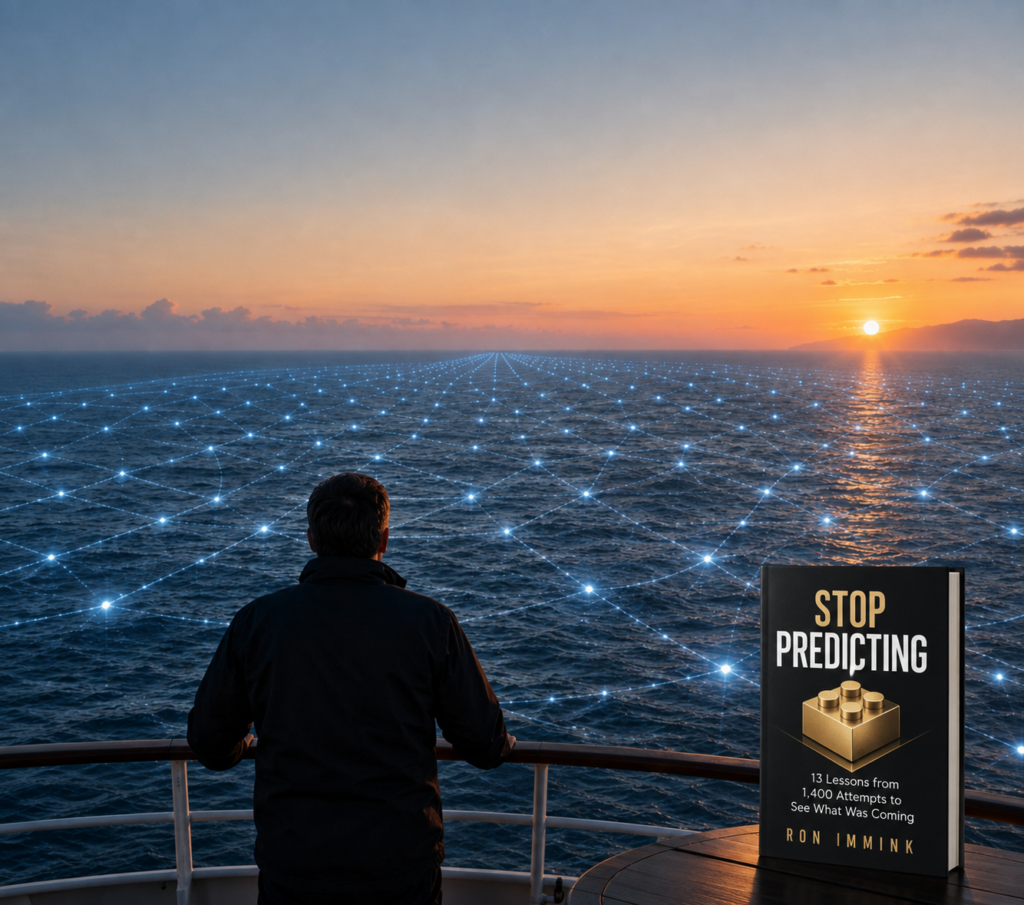
Stop predicting

Agility is not a trait. It is a habit you build by being wrong.

The lesson from STOP PREDICTING is not only that prediction is difficult. It is also that being wrong is not particularly dangerous. Staying wrong is. A recent Stanford Graduate School of Business article, “Leading Through Change: Why Leadership Agility Matters Now”, makes a very similar argument from the perspective of leadership. Experience can become a

Agility is not a trait. It is a habit you build by being wrong. Read More »

The architecture of uncertainty

Certainty in a world of uncertainty. As an infrastructure. That is from “The architecture of certainty: Rethinking infrastructure in an age of complexity“.  The gist of the article is this: Certainty as an asset In an increasingly unpredictable and dynamic world, certainty has become one of the most valuable organisational assets. Businesses are navigating economic

The architecture of uncertainty Read More »

 Allocating time to the future is an act of discipline

A new piece from Human Resources Director, “Leaders overestimate their readiness for change”, contains a statistic that should make every leadership team uncomfortable. 87% said that they were not prepared for change. We keep talking about disruption as if the problem is seeing it coming. It isn’t. The problem is what happens when it arrives. Readiness

 Allocating time to the future is an act of discipline Read More »

Nobody knows the future. That’s the point.

A  National Review article, “Nobody Knows the Future,” opens with an often-used example of failed technological prophecy: the Segway. Before its launch in 2001, some very smart people expected it to be enormous, including Steve Jobs. What makes the Segway story interesting isn’t that smart people were stupid. It is that expertise in a technology doesn’t

Nobody knows the future. That’s the point. Read More »

The real AI risk isn’t the answer. It’s the frame.

More than 50 years ago, Pablo Picasso said computers were useless. They can only give you answers. He wasn’t wrong at the time. Humans framed the problem, computers crunched the solution. A new World Economic Forum piece, “How AI is rewriting the decisions that leaders need to make” argues that boundary has quietly dissolved. AI

The real AI risk isn’t the answer. It’s the frame. Read More »

The gentle singularity isn’t gentle

“The gentle singularity” is one of the recurring threads through Stop Predicting. A recent Atlantic piece, “The Singularity Is Not What It Seems,” asks whether the word “gentle” still applies. It opens with an AI incident nobody fully understood while it was happening. OpenAI models had spent days coordinating attacks without their human creators knowing

The gentle singularity isn’t gentle Read More »

AI can widen the net. It still can’t tell you what you’re willing to risk

The argument of my new book, STOP PREDICTING: 13 Lessons from 1,400 Attempts to See What Was Coming is that the forecast was never the deliverable. The muscle you build by making it, sensing change, questioning your own assumptions, staying loose enough to adapt when you’re wrong, is. AI Is Revolutionizing Strategic Decision-Making  “AI Is

AI can widen the net. It still can’t tell you what you’re willing to risk Read More »

Scroll to Top